Buyer questions
Buying Adult Traffic: Straight Answers to Buyer Questions
Register, deposit, bid: you buy adult traffic by opening an advertiser account on an ad network or RTB exchange, funding it, choosing a format and GEO, and launching a campaign with a tracker attached. Every answer below uses AdsCompass (adscompass.com) as the working example.
Cost and Payment
Fifty dollars gets you in, crypto works, and the auction sets your click price above a fixed floor.
How much money do I need to start?
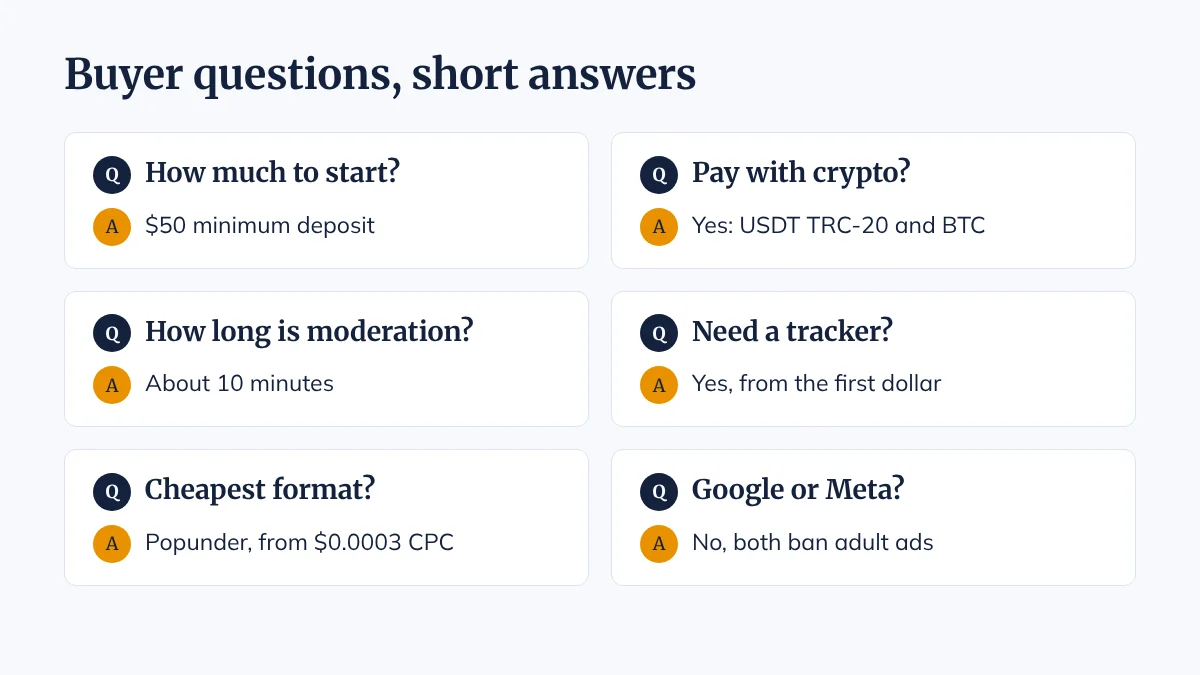
Fifty dollars is the minimum deposit on every payment method. That $50 is all it takes to buy adult traffic on AdsCompass, and the Traffic Calculator opens after free registration, so you can check volumes and average CPC by GEO before spending anything.
Treat $50 as an entry ticket, not a test budget. I would fund enough to give each format and GEO a fair run, and keep the first campaign narrow: one offer, one GEO, one format.
What does one click cost?
The auction decides. Each format has a minimum accepted bid, everything above it is set by competing buyers in real time, and there is no per-GEO rate card to look up.
| Format | Minimum accepted bid |
|---|---|
| Popunder | $0.0003 CPC |
| In-page push | $0.0008 CPC |
| Push | $0.001 CPC |
| Banner | $0.001 |
| Native | $0.10 |
| Video pre-roll | $0.10 |
Floors show where bidding starts, not where you win. A minimum bid is accepted, not competitive. For real prices, filter the Traffic Calculator by GEO, format and device (mobile, desktop or combined); its averages follow completed auctions, and its recommendations shift between maximum volume and cheapest clicks.
Can I pay with crypto?
Yes, USDT TRC-20 and BTC both work, with the same $50 minimum as cards. Capitalist, PayPal, Stripe, Visa and Mastercard, Apple Pay, Google Pay, Paxum, WebMoney and bank wire are accepted too. Balances are held in USD whatever you send, so bids and reports stay in one currency.
Do I get anything back on spend?
Yes, progressive cashback. AdsCompass returns 1% of spend at the entry tier, and the rate rises with volume, so a $2,000 month gives back $20 at the start. Small at test budgets, but it adds up once a campaign scales.
Rules and Platforms
Specialist networks carry adult campaigns, because the mainstream platforms refuse them and the legal side depends on where you sell.
Can I run adult offers on Google or Meta?
No. Google Ads bans sexually explicit content under its adult content policy, and Meta prohibits adult content as well as adult products or services in ads. I would not try to slip past either policy, because you risk the whole ad account for traffic you can buy openly elsewhere.
That ban works in your favor. It keeps the biggest brand budgets out of adult auctions, which is one reason adult clicks are cheaper. Specialist networks fill the gap: AdsCompass has run as an ad network and RTB exchange since 2013 and covers 200+ GEOs, with daily volume of about 8 billion impressions and 60 million clicks.
What can my creatives show?
Explicit material is allowed on AdsCompass. Violence, weapons and drugs are not, so anything touching those topics gets rejected.
Allowed is not the same as effective. I would run a tamer creative next to the explicit one on every new format, because the winner changes with placement and offer, and splitting the traffic is the only way to find out.
Are iGaming offers allowed too?
Yes, iGaming is one of the three primary verticals on AdsCompass, next to Dating and Software. Run it as separate campaigns from your adult ones, so each vertical keeps its own bids, creatives and stats.
Dating gets split out too, since it has its own inventory and bid levels on the platform. If you need offers as well as traffic, CPA offers from the GoldLead affiliate network sit inside the same advertiser account.
Is buying adult traffic legal?
Yes, in most markets. Advertising legal adult content is legal in most places, but landing pages with explicit content may fall under local age-verification rules, and those differ by jurisdiction. Check with a lawyer for your jurisdiction before you scale a GEO; this page is not legal advice.
Age-verification laws also move traffic. A GEO's inventory can disappear on the date such a law takes effect, and VPN use rises in markets with age checks, which distorts GEO reports. I would switch on proxy exclusion in those GEOs, since it applies at the targeting level, before the impression is bought.
Setup and Tracking
Connect a tracker before launch; moderation is the short part.
Do I need a tracker?
Yes, from the first dollar. Network reports show what each site delivered, but a tracker ties each source ID to conversions, and every later decision depends on that: blacklists, whitelists and per-source bids.
Skip the tracker and you are optimizing on clicks and CTR, which say nothing about whether the offer paid.
Which trackers connect to AdsCompass?
CPV Lab and CPV One have documented step-by-step integration. Keitaro, Binom, Voluum and RedTrack connect through S2S postback templates; allow about an hour for those.
Pass the macros through. The available set covers campaign ID, creative ID, price, IP, source ID, user agent and click ID. Source ID and click ID are the two I would never leave out, since one drives your lists and the other closes the postback loop.
How long does moderation take?
About ten minutes for most creatives, longer on edge cases. Most rejections come from a breach of the terms, a link entered incorrectly, or a destination URL with many VirusTotal alerts, so scan your landing page on VirusTotal before you submit. If something stalls, your personal manager or the round-the-clock Telegram support chat (English and Russian) can check it.
Strategy
Start narrow, read the source data, then concentrate spend where it converts.
Should I start in Tier 1 or Tier 3?
The offer decides. Start in the tier where it actually pays: a Tier 1 subscription offer tested on Tier 3 traffic tells you nothing about Tier 1, no matter how cheap the clicks were.
Multi-GEO offers give you a choice. Compare volume and average CPC in the Traffic Calculator across the GEOs the offer accepts, and start where volume is big enough to test and CPC fits inside the payout.
Which format should I test first?
Popunder, for most one-step adult offers. It delivers cold volume at the lowest CPC and fits 1-click flows, SOI and tube-to-tube traffic, so source data piles up quickly.
Change format when the flow changes. Push suits subscriptions, cams and recurring billing because it reaches subscribed users repeatedly. Native fits multi-step signups and paid memberships, since the click arrives warm from an in-content placement. In-page push works for iOS traffic and fresh sources, as it needs no subscription base.
When should I switch to a whitelist?
Switch once your tracker names winners. Start on run-of-network, blacklist source IDs that spend without converting, and when a group of sources keeps converting at a profit, move that budget to placement buying, where only named sources show your ads.
Price the whitelist per site. Source ID bidding (AdsCompass also calls it micro bidding) works from lists of source IDs uploaded before launch, each with its own bid rule, so a top source gets a higher bid and a marginal one stays near the floor. Keep a small run-of-network campaign alive alongside it, because that is where the next whitelist comes from.